
The Trial Reservoirs Initiative is scaling water innovation from trials to implementation, delivering measurable impact, funding and climate benefits.
From concept to implementation – and what comes next
At a glance
The Trial Reservoirs Initiative has moved from concept to delivery.
- 450+ companies engaged in the pipeline
- 18 trials initiated, with 13 successfully completed
- £2 million in external funding unlocked
- Active expansion into new geographies and sectors
- A growing focus on measurable climate impac
More importantly, these trials are generating measurable outcomes, not just insights, but evidence that informs real-world decisions.
This blog focuses on where the initiative stands today, and what that means for the sector.
Moving beyond the pilot cycle
The challenge the Trial Reservoirs Initiative was designed to address is well understood.
Technologies often stall between validation and adoption, not because they don’t work, but because the conditions for implementation aren’t there. Risk sits in the wrong place, incentives are misaligned, and trials become isolated exercises rather than steps toward deployment
We’ve explored this in more detail in previous blogs:
From ecosystem risk to operational reality: why utilities can no longer afford to wait
Trends in Trials: What Funding Patterns Tell Us about the Future of Water Innovation
The Trial Reservoirs Initiative Four Years On
Turning Water Innovation from Risk to Reliable Implementation
Five Bottlenecks That Derail Water Tech Trials, and How to Avoid Them
A model designed for implementation
Rather than increasing the number of pilots, the Initiative changes how trials are delivered.
In simple terms, it:
- Shares financial risk between stakeholders
- Defines success upfront through clear KPIs
- Provides independent validation of outcomes
- Creates a pathway to cost recovery if trials succeed
If you want a deeper breakdown of how this works in practice:
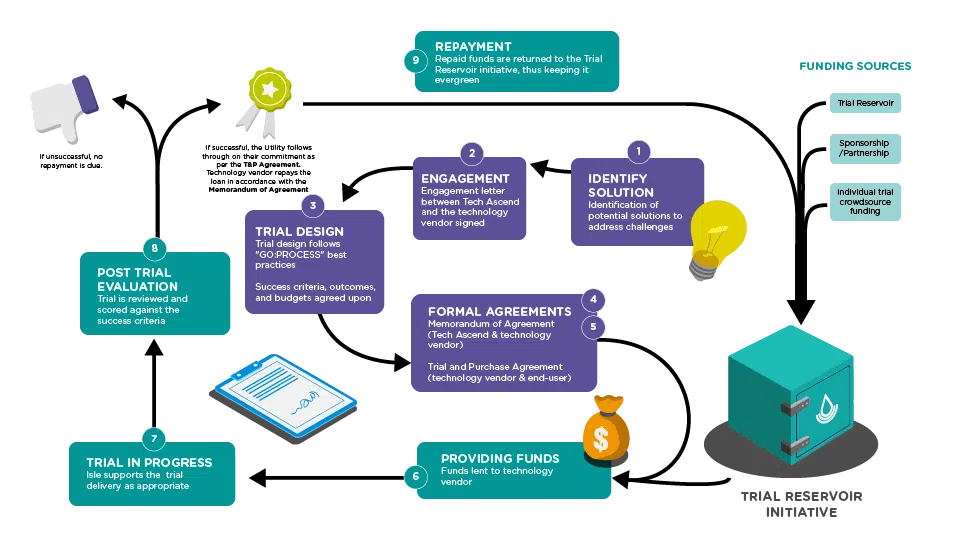
The result is more structure route from trial – decision – implementation.
Progress to date: evidence over expectation
The initiative is no longer theoretical.
Across completed trials, outcomes have included:
- Up to 71% reduction in water use in sanitation applications
- Around 30% energy savings in wastewater treatment
- Significant reductions in industrial wastewater load and operational costs
- Improved asset insight through non-invasive monitoring technologies
These results are important, but they are only part of the story.
What is becoming clearer is that these trials are not isolated successes. They are building a repeatable evidence base that utilities and industrial users can act on with confidence.
From trials to climate impact
One of the more significant developments in the Trial Reservoirs Initiative’s growing role in supporting decarbonisation.
Current trials are already delivering measurable greenhouse gas reductions, including:
- Reduced energy consumption in treatment processes
- Lower transport emissions through operational efficiency
- Reduced chemical demand and associated carbon impacts
- Targeted reduction of high-impact emissions such as nitrous oxide (N₂O)
Based on completed and active trials, the initiative is currently delivering an estimated ∼188 tonnes CO₂ annually as technologies are deployed more widely.
This is where the model begins to shift from supporting individual trials to enabling system-level impact.
A key mechanism behind this is the move toward framework deployment, where a successful trial can unlock rollout across multiple sites, rather than remaining a single demonstration.
Scaling the model
The Trial Reservoirs Initiative has evolved significantly since its launch.
- First launched in 2021 to address the “piloting valley of death”
- Expanded into multiple thematic areas, including climate and industrial applications
- Now operating under the Tech Ascend Foundation, established in 2025 to scale the model globally
It is also expanding geographically, with active plans to grow across the US, Brazil, and other regions where the need for implementation pathways is particularly acute.
This scaling is not just about geography, it is about increasing the rate at which proven technologies move into use.
What this means for the sector
For utilities, the Trial Reservoirs Initiative provides a more practical way to engage with new technologies, reducing exposure while enabling informed decision-making.
For technology companies, it offers a credible route to first deployment, often the most difficult step in scaling.
More broadly, it reflects a shift in the sector: from identifying solutions to implementing them at pace.
Where the Trial Reservoir Initiative is heading
The next phase is focused on expanding participation while maintaining the quality and credibility of trials.
Applications are now open, with continuous focus on:
- Climate mitigation and resilience technologies
- Advanced and industrial treatment
- Resource recovery and circular approaches
- Emerging contaminants
Alongside this, there is a growing emphasis on:
- Larger, more complex trials
- Cross-site deployment models
- Stronger alignment with corporate and utility net-zero commitments
Apply today to the Trial Reservoirs Initiative
For utilities and industrial end users, the challenge is no longer identifying potential solutions – it’s implementing them with confidence.
The Trial Reservoirs Initiative provides a structured way to do that:
- Text technologies in real operating conditions
- Define success upfront through clear KPIs
- Generate independent, decision-ready evidence
- Reduce financial and operational risk during the process
If you are facing operational, environmental, or regulatory challenges, and need a more practical route to evaluating and implementing solutions, the next step is straightforward.
Applications are now open.