

PFAS in water is shifting from a treatment issue to a system-level challenge, reshaping regulation, monitoring and utility decision-making.
Insights from the PFAS Forward Summit, and what they mean for water utilities.
When you strip away the headlines on PFAS, tightening regulation, new treatment technologies, rising costs, the real story is more subtle.
It’s not about a single breakthrough or point of contention. It’s about a shift in how the problem itself is being understood.
Based on Insights from a recent PFAS Forward Summit, three themes are starting to define how the sector is moving forward: scale, visibility, and system integration.
1. The scale problem is bigger than most frameworks can handle
Most regulatory and scientific discussions focus on a few thousand well-characterized compounds. But depending on how PFAS is defined, that number expands significantly:
- Over 7 million PFAS-like structures under OECD definitions
- More than 8 million when grouped by subclasses
- Potentially tens of millions when broader fluorinated chemistries are included
PFAS are not a fixed list, but a large, structurally defined and evolving class of chemicals, with varying levels of characterization across individual compounds.
This creates a practical challenge, not because PFAS cannot be defined, but because their scale makes chemical-by-chemical regulation impractical.
As a result, regulation is shifting toward group-based approaches, focusing on representing compounds rather than attempting to cover every substance individually.
At the same time, advances in analytical science and data-driven tools are improving how substances are grouped, prioritized, and assessed, supporting more practical, system-level regulation.
2. Detection is shifting from precision to exploration
That shift in regulatory thinking is mirrored in how PFAS is being monitored.
Traditional monitoring, target analysis, focusses on known compounds. It works well, but only within the boundaries of what’s already understood and regulated.
Non-target analysis (NTA), by contrast, is being used to explore what sits outside those boundaries:
- Previously unknown or unregulated PFAS compounds
- Transformation products formed in the environment
- Additional chemical signals not captured through standard methods
What’s changed is not the technology itself, but its role. NTA is no longer confined to research environments. It’s now informing:
- Early warning systems
- Regulatory investigations
- Industrial risk assessments
At the same time, even targeted analysis involves trade-offs. There are estimated to be around 12,000 PFAS compounds. In theory, each one could be tested individually, but in practice, testing costs scale with the number of compounds measured.
As a result, monitoring frameworks deliberately focus on a subset- typically groups such as PFAS-4, PFAS-20 or PFAS-22 , selected because they are:
- The most prevalent
- The most toxic
- Or the most reliably measurable.
This means that when a result shows, for example, 50 ppt for PFAS-20, it does not represent the total PFAS present in the water. It reflects the most relevant and representative compounds within a much larger set.
Expanding analysis to hundreds or thousands of compounds is technically possible, but comes with rapidly diminishing returns in insight, at a disproportionately higher cost.
In practice, the sector is shifting toward broader visibility combined with prioritisation, expanding what can be detected, while still making pragmatic decisions about what is feasible to measure.
3. Regulation is tightening, but not aligning
Globally, PFAS regulation is becoming more stringent, but not more consistent.
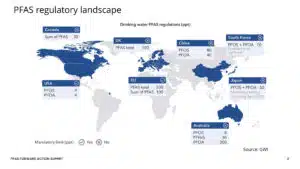 Different regions are taking distinct but well-established approaches:
- The United States: ultra-low limits (4 ppt) for specific compounds
- The European Union: dual thresholds (500 ppt total / 100 ppt subset)
- The UK: 100 ppt total PFAS
- Asia-Pacific markets: a mix of compound-specific limits with varying ambition
Even within Europe, the picture is more nuanced than headline figures suggest.
Thresholds vary depending on which PFAS groups are being measured, and in some cases, when regulations come into force.
For example:
- Germany applies 100 ppt for PFAS-20, with 20 ppt for PFAS-4 expected from 2028
- Denmark sets a lower 2 ppt limit for PFAS-4, while aligning more closely at 100 ppt for broader groupings (PFAS-22)
- The UK’s 100 ppt total PFAS limit is based on a broader grouping (PFAS-48), rather than a small subset of compounds.
So while it’s presented as a wide divergence between countries, the reality is more measured:
- Variation is most pronounced in a small-group threshold (e.g., PFAS-4)
- There is greater alignment at broader group levels (around 100 ppt)
For utilities, this adds to an already complex compliance landscape. Managing multiple contaminants each with its own limits, monitoring requirements, and treatment approaches, is well established practice.
PFAS increases the scale and pace of change, requiring utilities to respond to broader definitions, tighter thresholds, and more dynamic regulatory expectations.
4. Investment is growing, but so it the gap
Drinking Water treatment spending in Europe is projected to grow significantly between 2025 and 2031, with capital investment concentrated in a small number of established technologies:
- Granular Activated Carbon (GAC) a the dominant solution
- Reverse osmosis and nanofiltration (RO/NF) for higher-spec applications
- Ion exchange (IX) a well-established technology, with new PFAS-selective resins continuing to develop
This distribution reflects a continued reliance on proven technologies like GAC and IX, while innovation is increasingly focused on improving performance, selectivity, and operational efficiency.
GAC remains widely used due to its effectiveness and maturity, but it also comes with some operational considerations, including carbon footprint, regeneration requirements, and the logistics of off-site incineration and transport. These factors are driving interest in both alternative treatment approaches and improvements to existing systems.
At the same time, advances in selective materials and regeneration methods are gaining attention, aiming to reduct lifecycle impacts while maintaining or improving performance.
Alongside this, the scale of the PFAS challenge remains substantial.Estimates suggest that less than 1% of PFAS emissions are currently removed annually in Europe, equivalent to only a small fraction of total emissions.
Taken together, this highlights that the gap is not just technical. The challenge is shifting from how we treat PFAS to how to manage PFAS across the water system, including treatment, source control, residual handling, and long-term environmental impact.
5. The cost conversation is shifting – fast
Long-term cost projections are starting to reshape decision-making.
- Health-related costs linked to PFAS exposure in Europe could reach €438 billion by 2050
- A more realistic scenario, where emissions continue, pushes total costs toward €2 trillion over 20 years
Annual costs escalate sharply when broader PFAS groups are included:
- Drinking water: up to €65 billion per year
- Wastewater and sludge: tens of billions more
At the same time, investment in drinking water treatment is increasing, driven largely by tighter regulation. Utilities across Europe are expected to invest billions of euros in PFAS treatment over the coming decade, supported by wider European funding for water resilience, infrastructure and emerging treatment technologies.
This shifts the conversation from the cost of treatment alone to how investment is balanced across prevention, treatment, and long-term system resilience.
6. Utilities are starting to think beyond PFAS in isolation
Utilities are increasingly managing PFAS alongside other system-wide risks.
- PFAS is typically treated as an acute, localized risk, linked to contamination and public health
- Climate change is a system-wide, chronic risk, affective availability and resilience
But that separation is starting to break down, there is a growing recognition that PFAS needs to be addressed within a broader water system context, including:
- Source control and industrial pathways
- Treatment and disposal implications
- Impacts on water reuse
- Links to wider environmental pressures
This aligns with broader sector research priorities, where emerging contaminants and climate resilience are increasingly being addressed together rather than separately.
7. Accountability is coming, but unevenly
Enforcement and financial accountability for PFAS contamination are beginning to shift upstream.
Legal and regulatory pressure is increasingly targeting producers rather than leaving utilities to absorb the full cost of treatment and remediation. In several jurisdictions, this is already translating into large-scale settlements and liability claims, alongside legal precedents that support holding polluters accountable for emissions and associated impacts.
This introduces a potentially significant shift in how PFAS risk is managed and funded.
However, progress remains uneven, highly dependent on jurisdiction, legal frameworks, and political will.
The takeaway: PFAS is becoming a system problem, not a technical one
The sector is moving beyond seeing PFAS as a treatment challenge.
It is increasingly understood as:
- A definition problem (what qualifies as PFAS)
- A measurement problem (what is practical and meaningful to monitor)
- A regulatory problem (how frameworks evolve)
- A system problem (how it connects to wider water management challenges)
In practice, leading approaches are starting to converge around:
- Prioritised monitoring, focusing on representing PFAS groups rather than exhaustive testing
- Risk-based decision making, aligning investment with known exposure and regulatory direction
- Integration into wider system planning, particularly where PFAS intersects with reuse, residuals management, and long-term resilience.
Those who move early to align monitoring, regulation, and system planning will be better positioned, not just to respond to PFAS, but to manage the broader shift toward more complex and less defined water quality risks.