Industrial water innovation is entering a more demanding phase. At Isle’s Industrial Water Forum, held at TU Delft during Water in Industry 2026, cross-sector panellists explored what it actually takes to move water efficiency and reuse projects from pilot to full-scale implementation.
Industrial Water Forum reflections
Industrial Water Forum reflections: from ambition to implementation
Industrial water innovation is increasingly shaped by business risk, operational reality and the ability to move from pilots to implementation.
The technologies, targets and circular water ambitions are already part of the conversation. The harder task is turning them into projects that can operate reliably inside complex industrial sites, where production continuity, compliance, cost, water quality and reputation all matter at the same time.
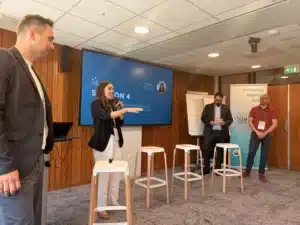
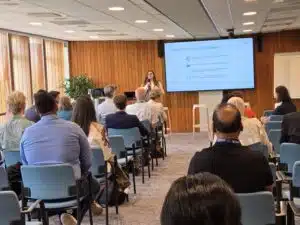
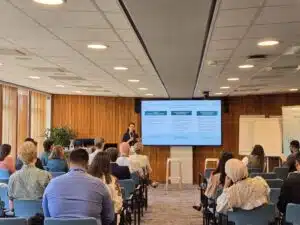
That was one of the clearest messages from the Industrial Water Forum, hosted by Isle at TU Delft as part of Water in Industry 2026 (organised by the International Water Association).
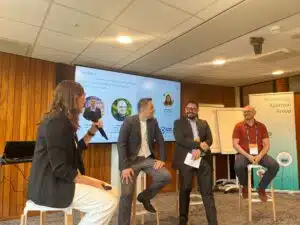
The half-day forum brought together industrial end-users, technology experts and water professionals to discuss practical approaches to water efficiency, reuse, resilience, system optimisation and technology adoption.
The value of the discussion also came from the diversity of industrial perspectives represented. Panellists brought experience from food and beverage, agribusiness, speciality chemicals, energy, steel and water treatment.
Water is becoming a strategic business risk
For many industrial companies, water has moved beyond the category of operational utility. It is increasingly being treated as a strategic business risk
The challenge highlighted by participants is not only how much water a company uses, but where it is used, how secure the supply is, what happens when availability or quality changes, and how dependent operations are on water at critical sites.
Industrial companies need to address water risk across their wider value chain while also demonstrating credible, measurable action at site level. Corporate targets alone are not enough. Businesses need clear data, defined operational ownership and investment decisions that prioritise the sites and processes where water risk could have the greatest commercial impact.
The strongest strategies connect long-term resilience goals with practical action: reducing avoidable demand, identifying viable reuse opportunities, strengthening supply resilience and building the business case around avoided disruption, regulatory exposure and operational continuity.

The 4Rs journey becomes harder as ambition increases
The 4Rs framework gives companies a clear structure: reduce, reuse, recycle and reclaim. But these are not equal steps. As companies move through the framework, the technical, operational and commercial complexity increases.
Reduction is usually the first and most attractive step. It often has the fastest payback, carries the lowest operational risk and the clearest link to efficiency. Detailed site assessments and water audits can identify opportunities such as leaks, excessive blowdown, unnecessary discharge, inefficient cleaning processes and cooling water opportunities.
Several panellists stressed that the biggest opportunities are often found upstream in the production process, rather than at the end of the pipe. Preventing contamination, treating it closer to source, segregating streams and understanding where water quality changes across the process can create better options.
Reuse and recycling bring additional value, but also require closer attention to water quality, process reliability, site integration, and operational ownership. A technically viable solution would still struggle if operators do not trust it, regulators are not engaged early or the system does not fit existing processes
Reclaim is often the most challenging stage. It can involve higher capital costs, food safety concerns, reputational risk, stakeholder acceptance and complex operating requirements.
The question is whether a company can reuse water safely, reliably, and economically in a way that operators, regulators, customers and communities can trust.

Scarcity is changing the business case
Examples from water-stressed regions in Europe and beyond, including France, Spain and Slovakia, showed that scarcity alone does not automatically create a strong business case for investment.
In many regions, water remains relatively inexpensive. That makes it difficult to justify investment based only on reduced water bills. Even where water stress is severe, the financial case for reuse, recycling or advanced treatment can be difficult to quantify through direct utility savings alone.
The strongest business cases therefore connect water investment to avoided production losses, downtime, compliance issues, business interruption, reputational damage and constraints on future growth.
A project that looks unattractive when evaluated only on water tariff savings may look very different when assessed through total cost of ownership, resilience, regulatory exposure, energy impact, production continuity and long-term licence to operate.

Water decisions cannot be separated from energy, carbon and people
Water projects can also create trade-offs: reducing water consumption or introducing advanced treatment may increase energy demand, affect carbon targets or add operational complexity. These impacts need to be assessed together rather than treated as separate decisions.
Forum participants also highlighted a growing capability risk. Experienced operators are leaving, staff turnover is increasing and valuable site knowledge is being lost. Advanced technologies may be available, but sites still need people who understand how to run them, maintain them and respond when conditions change.
Corporate water targets will only succeed if local teams have the skills, time, authority and confidence to implement changes safely. This makes training, internal knowledge-sharing, supplier-supported learning and more direct engagement with operators during project development not optional extras added after installation
Technology adoption depends on site reality
Participants discussed a wide range of technologies, including membranes, advanced oxidation, electrodialysis, membrane distillation, biogas recovery. The conclusion was consistent: technical performance is only part of successful adoption.
A technology may work in a laboratory and still fail during a pilot. It may succeed in a pilot and still prove unsuitable at full scale. Treatment performance alone is not enough if chemical consumption is too high, integration is too complex, space is limited, maintenance requirements are unrealistic, or the site conditions differ from those assumed.
Piloting remains essential, but it is designed to test the realities of implementation. That means understanding how the system responds to changing water quality, what operator skills are required, how it will integrate with existing processes and what full-scale operation will genuinely cost. A good pilot does not simply prove that a technology works; it identifies whether it can work reliably and economically at that specific site.
What the forum showed
The Industrial Water Forum showed that industrial companies are serious about water, but also realistic about the barriers to action
Industrial companies are not short of ambition. Many have water targets, stewardship programmes, reuse ambitions and innovation pipelines. But they are also dealing with cost pressure, production risk, ageing infrastructure, regulatory uncertainty, skills shortages and complex internal decision-making.
The cross-sector nature of the forum reinforced that many companies are facing similar pressure, but there is no universal route to implementation. The right solution depends on the industry, the process, the wastewater, the site and the level of risk the business is prepared to accept.
This is why peer learning and informed technology selection matter. The most valuable insights often come from organisations that have tested solutions, built business cases, engaged operators, faced setbacks and learned from implementation.
The discussion in Delft pointed to a practical challenge for industrial water users: how to turn ambition, targets and technology options into projects that can survive real site conditions.
That means looking beyond technical performance alone. It means understanding the process, the wastewater, the operators, the economics, the regulatory context and the level of risk the business is prepared to carry.
For industrial water, the next phase will be defined by implementation quality: selecting the right opportunities, testing them properly, building credible business cases and creating the internal confidence to scale what works.